Greetings from Scoutable and welcome to our Quarterly Wrap Up.
I hope you are well.
The Reserve Bank of Australia left the cash rate at 4.1% at its July meeting. The pause was a welcome relief for borrowers. However, it may be short lived as the Reserve Bank mentioned that further rate rises may be required to tame inflation, with many expecting another hike to come as early as next month.
RateCity published an article on the 30th June, summarising the big four bank's predictions of cash rate movements over the next couple of years. See below.
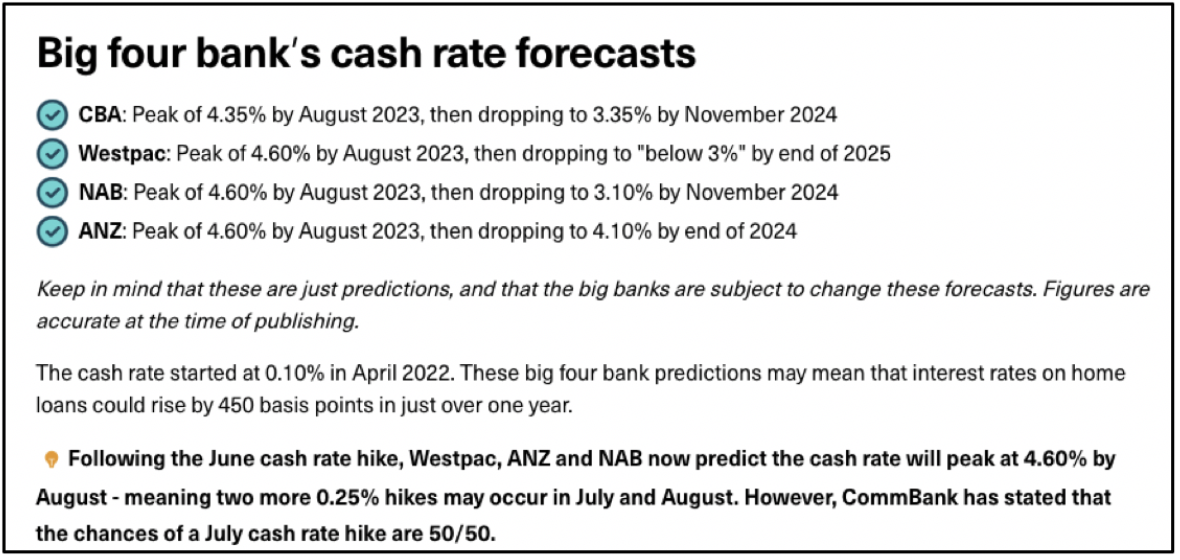
RateCity crunched the numbers on an average $500,000 loan, with a 25-year term.
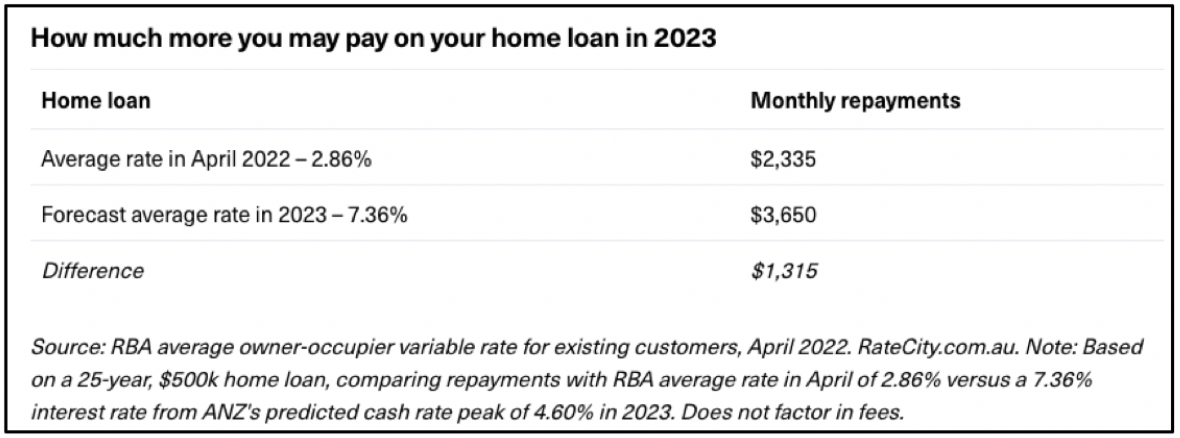
This is a significant increase which RateCity compared to buying a new iPhone every month! Increased interest rates do not only affect the loan repayments but also serviceability (i.e. how much a bank is willing to lend you after factoring in your income and expenses).
RateCity completed a comparison for the ‘average’ family of four, who have a combined income of $143,221 before tax, showing a reduced borrowing power of $247,700 after the 12 RBA rate increases. See table below.
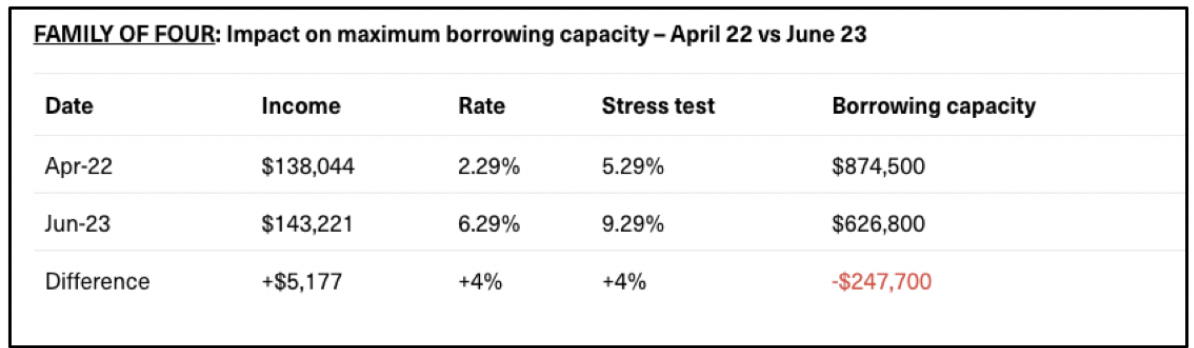
*Source: RateCity.com.au - This assumes they have no other debts, minimal expenses and have had a 3.75 per cent pay rise over the last year. These calculations are estimates only. The amount someone can borrow depends on their personal situation and/or their lender. Calculations are estimates based on CBA’s serviceability calculator on a 30-year principal and interest loan with a big four bank.
For a single person earning the average wage, with no debts, no dependents and minimal expenses, the maximum amount they can borrow from the bank will have dropped by $180,000 in the last 14 months.
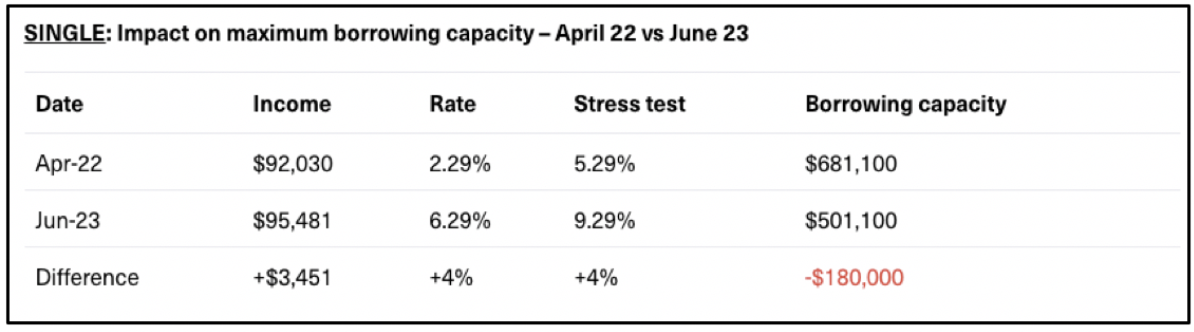
*Source: RateCity.com.au - This assumes they have no other debts, minimal expenses and have had a 3.75 per cent pay rise over the last year. These calculations are estimates only. The amount someone can borrow depends on their personal situation and/or their lender. Calculations are estimates based on CBA’s serviceability calculator on a 30-year principal and interest loan with a big four bank.
Given the interest rate environment, one would think this would have a negative impact on the property market, expecting distressed sales / more stock and buyers with reduced buying power resulting in lower sale prices. However, this isn’t happening (yet).
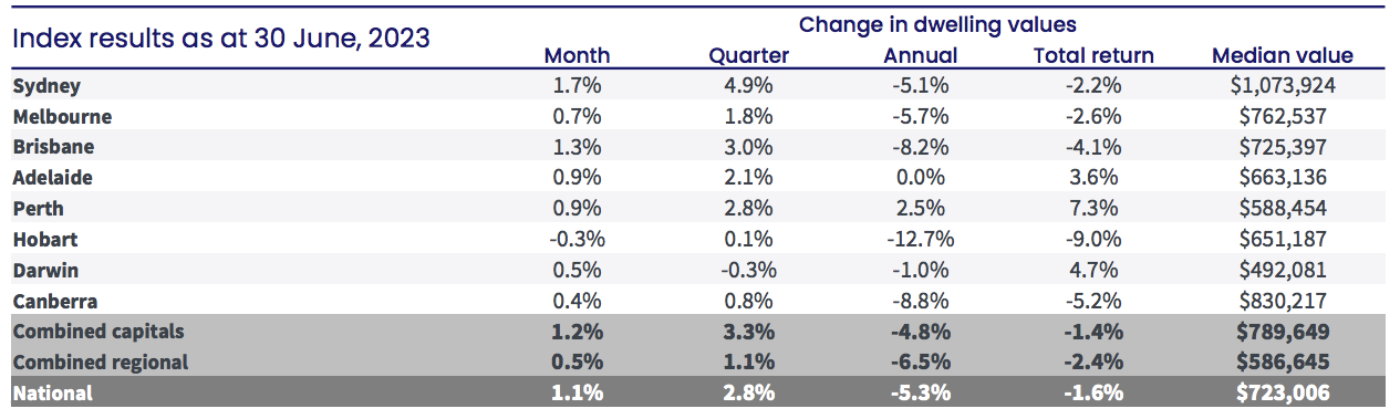
CoreLogic’s national Home Value Index reported an increase of 1.1% in dwelling values across Australia in June 2023. This is a slight reduction in the growth from May (1.2%). National dwelling values have increased 3.4% since February 2023. However, the market is still 6% below peak levels recorded in April 2022.
The major factor driving this growth is reduced stock levels. CoreLogic reported capital city listings are nearly 10% below the previous five-year average and total inventory levels are more than a quarter below average.
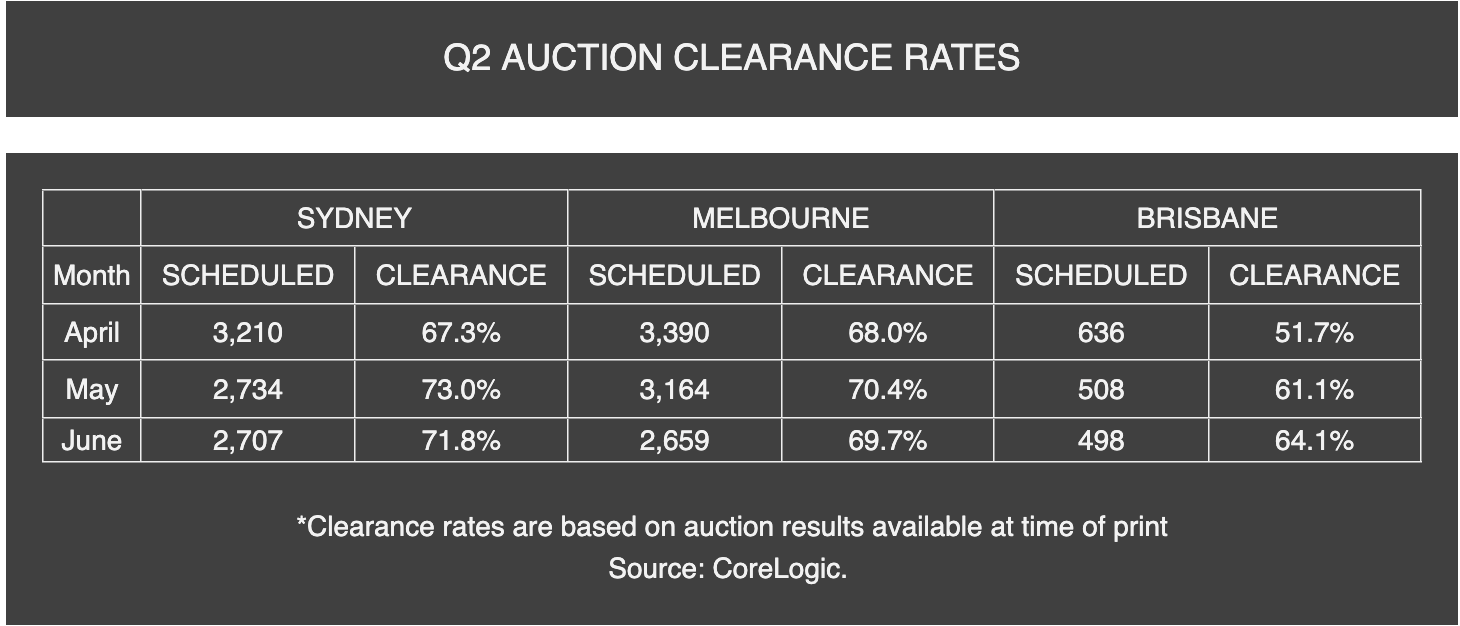
Looking across Q2 2023, Sydney reported a 4.9% gain, Melbourne 1.8% and Brisbane 3.0% in the Home Value Index. Compared to Q1 2023 results of Sydney reporting a 0.4% gain, Melbourne -0.9% and Brisbane -1.7%.
See below CoreLogic Home Value Index results as at 30th June.
Despite recent positive market movements, the outlook is still uncertain. The RBA has estimated 880,000 fixed rate mortgages will expire in 2023 (those borrowers will face increase rates from 2% to over 6%). Along with negative real income growth and higher cost of living, it would be reasonable to expect mortgage pressure over the coming six months. That said, on the ground, we are still seeing strong buyer confidence. Factors which could mitigate a future potential fall in the market include, increased net migration (almost 27% above the previous recorded high in 2008), reduced supply (including new construction) and low unemployment.
Rental Update
The annual rental market growth over 12 months to June 2023 was recorded at 11.5% across the combined capital cities, slightly down from 11.7% over the 12 months to April 2023. CoreLogic reported ‘Although easing, the larger capitals continue to record stronger rental appreciation, especially across unit markets, where overseas migration and insufficient rental supply is continuing to place upwards pressure on rents’
Vacancy rates across the combined capitals have risen from 1.0% earlier this year to 1.1%, but are holding well below the decade average of 2.8%. CoreLogic report ‘Despite such tight vacancy rates, it’s likely the trend in rental appreciation will continue to moderate, simply due to rental affordability pressures forcing a change in rental household formation. The early signs of a rebound in the average household size can already be seen in data published by the RBA’
Government News
From the 1st July 2023, first home buyers in NSW will have access to stamp duty concessions for a purchase price of $1m, with no stamp duty payable under $800k (increase from previous cap of $650k) and reduced duty up to $1m (previous cap of $800k). Figures below published by ninenews.com.au on the 1st July.
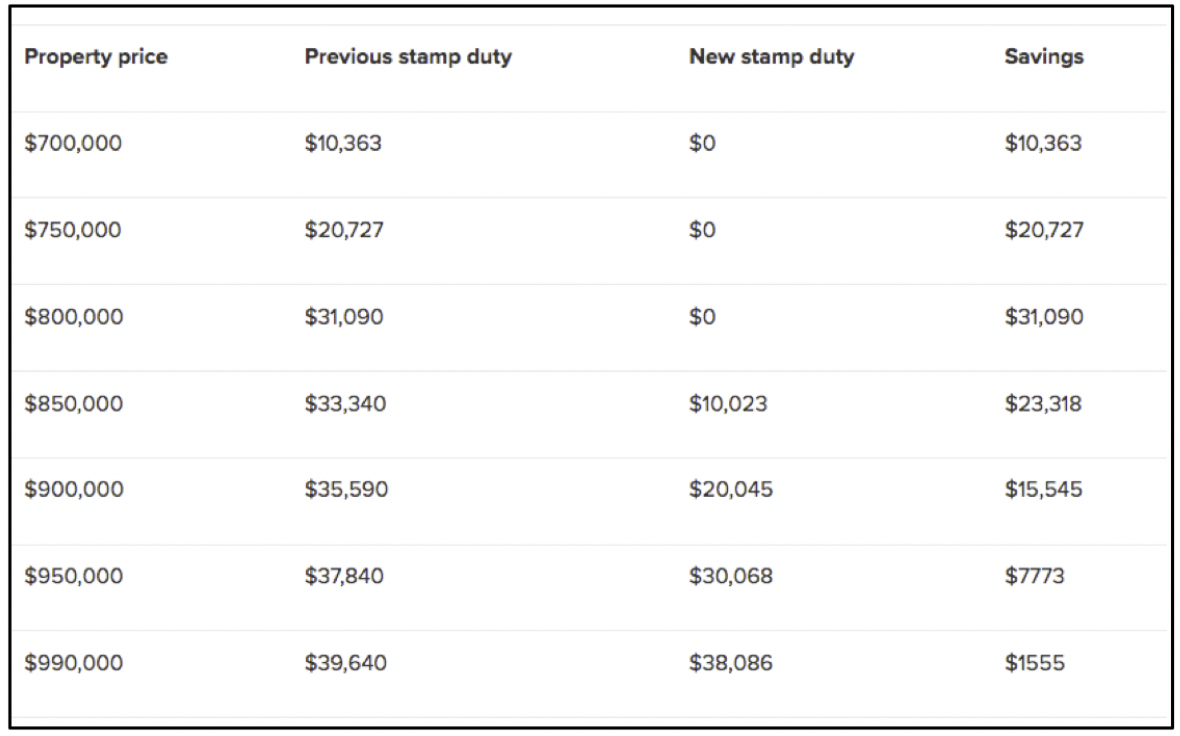
In the past with any first home buyer government incentive, we usually see in an increase in market movement in proportion with the incentive. It will be interesting to see if properties, especially sub $850k, have an artificial increase.
If you would like to discuss the property market further, please get in touch.
Until next quarter,
Kellie Landrey | Principal Buyers Agent