
Happy New Year from Scoutable and welcome to our Quarterly Wrap Up.
I hope you are well.
Cash Rate
At its December meeting, the Reserve Bank of Australia left the cash rate at 3.6%, which has remained since August 2025. The Reserve Bank will hold its first cash rate meeting for 2026 in February.
RBA Governor Michele Bullock has signalled that the Bank is likely to keep the official cash rate on hold and not pursue further cuts in the near term, emphasising caution given inflation’s persistence. After the December 2025 decision to leave the cash rate at 3.60%, Bullock noted that inflation data had come in stronger than expected and that the Board needs to be cautious in interpreting the outlook rather than immediately cutting again. She has been clear that future decisions will be data-dependent, without committing to either cuts or rises, and has acknowledged that if inflation remains elevated, further rate increases cannot be ruled out. More information via the link.
Market Update
Cotality’s national Home Value Index (HVI) rose 8.6% in 2025, 4.9% in 2024, following 8.1% in 2023, -4.9% in 2022 and +24.5% in 2021. HVI 4th quarter for 2025 reported a slight growth of 2.9%, a minor increase from Q3’s growth of 2.2%. Looking at the Home Value Index of capital cities for Q4 2025, 0.8% was reported in Sydney & Melbourne and 5.6% in Brisbane. Perth lead the chart with a 7.6% gain.
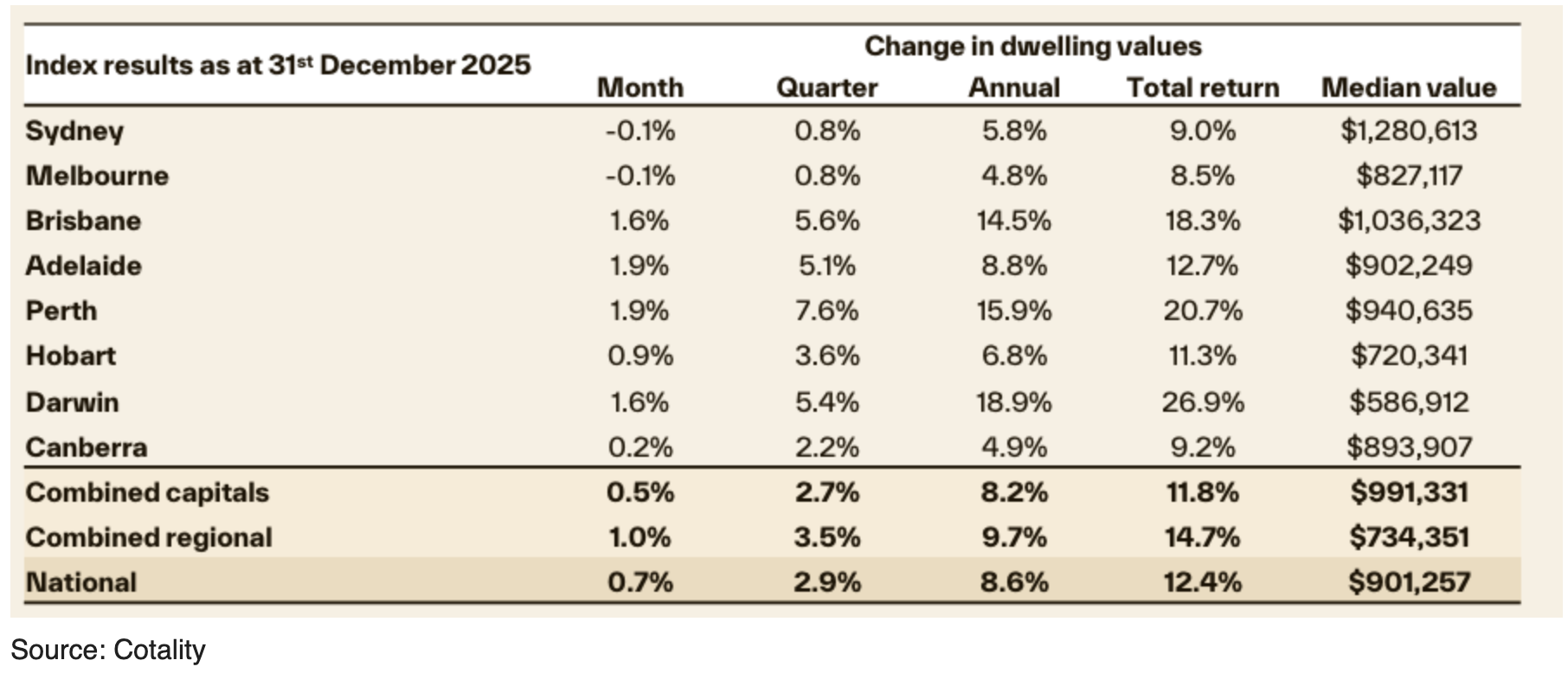
Tim Lawless, Cotality’s research director, noted, “The softening hints at a weaker start to housing trends in 2026. Renewed speculation that the rate-cutting cycle is over and the next move from the RBA could be a hike has dented housing confidence. A ‘higher for longer’ setting on interest rates, alongside a resurgence in cost-of-living pressures and worsening affordability pressures, looks to have taken some heat out of the market.”
Looking forward 2026
Cotality HVI suggests the Australian housing market is unlikely to see the same level of growth in 2026 as in 2025, due to inflation, interest rates, and affordability pressures. Noting the following:-
Inflation risks are rising, with headline inflation at 3.8% and core inflation at 3.3%, keeping the RBA focused on a “higher for longer” cash rate.
Interest rates remain elevated at 3.6%, above the pre-pandemic average of 2.5%, stretching mortgage serviceability; households may spend ~45% of pre-tax income on a median-priced home.
Housing demand is shifting to lower and middle-price segments, driven by first-home buyers and investors, as APRA monitors household debt and lending standards.
Affordability pressures are significant: median-income households face an 8.2 dwelling value-to-income ratio, 11 years to save a 20% deposit, and renters spend 33.4% of pre-tax income on rent.
Support factors include low housing supply and government incentives for first-home buyers, helping maintain momentum at entry levels.
Outlook: Modest, uneven growth is expected, with structural undersupply and targeted stimulus mitigating major price falls despite downside risks.
In summary, The Australian housing market is expected to see modest, uneven growth in 2026, as high costs and affordability pressures weigh, but low supply and targeted incentives provide support..
SQM Research produce a forecast report each year, Christopher’s Housing Boom and Bust Report. The 2026 report was released 25th November 2025.
The Base case forecast is for average national dwelling prices to change between +6% to +10%.
The forecasts are based on three important assumptions:
Population growth: Moderates to ~390,000 (1.4%), creating demand for ~150,000 dwellings.
Dwelling completions: Rise to ~180,000, producing a small surplus of ~30,000 dwellings.
Interest rates: Remain steady until mid-2026, with 1–2 cuts of 0.25% expected in the second half of the year.
Employment: Growth slows, pushing unemployment to ~5%.
Economic conditions: Slower economy with some early-year inflation concerns; RBA likely to focus on supporting growth in the second half of 2026.
Christopher’s Housing Boom and Bust Report 2026 noted on their assumptions:"Of course, there are a number of assumptions in our base case, hence why we always run alternative scenarios. The next most likely scenario in our view is that inflation remains sticky despite rising unemployment. This would stay the RBA’s hand and in a worst-case scenario an interest rate rise could be possible for 2026. But with falling oil prices around the world and slower economies, we think, while possible, it is not the most likely scenario".
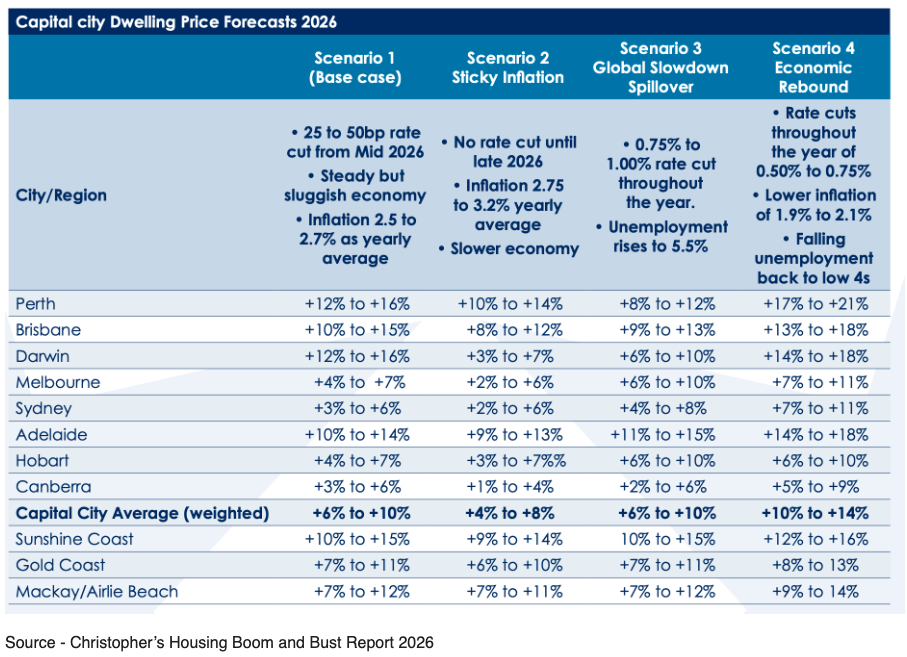
As noted last year, global events, net migration, affordability constraints, inflation, interest rate movements, APRA serviceability buffer rate (rate which is applied to loan serviceability assessments), supply and consumer confidence are key factors to market movements over the next 12 months. The unknowns of the market moving forward is a timely reminder that property should be viewed as a long term investment.
If you would like to discuss the property market further, please get in touch.
Until next quarter,
Kellie Landrey | Principal Buyers Agent