
Greetings from Scoutable and welcome to our Quarterly Wrap Up.
I hope you are well.
CASH RATE
At it's June meeting, the Reserve Bank's Monetary Policy Board left the cash rate unchanged at 4.35%, following three consecutive 25-basis-point increases this year — in February, March and May. The Board noted that headline and underlying inflation remain too high, having picked up in the second half of 2025 due to capacity pressures in the economy. A separate, more recent inflation impulse is now coming from the Middle East conflict's disruption to global oil supply, which has pushed up fuel prices and is starting to flow through to other goods and services. With financial conditions tighter after this year's rate rises, and early signs of slowing consumer spending and a cooling housing market, the Board judged it appropriate to hold steady while assessing these effects — but signalled it would raise rates further if inflation doesn't return to target.
Source: Statement by the Monetary Policy Board, Decision No. 2026-15, 16 June 2026
BUDGET
The negative gearing and capital gains tax reforms announced in the 2026–27 Federal Budget have now passed into law. From 1 July 2027, negative gearing will be restricted to new dwellings only, and the 50% CGT discount will be replaced with cost-base indexation and a 30% minimum tax rate.
Properties held before Budget night (7:30pm AEST, 12 May 2026) are grandfathered under the old rules for negative gearing, and the inflation-based CGT treatment only applies to gains accrued from 1 July 2027. Investors in new dwellings retain the choice between the 50% CGT discount and the new indexation treatment — a deliberate incentive to redirect capital toward new housing supply.
Negative Gearing: From 1 July 2027, losses on established investment properties can no longer be immediately offset against income. Instead, they are quarantined and carried forward against future rental income or capital gains.
Capital Gains Tax: The 50% CGT discount is replaced by cost-base indexation with a 30% minimum tax rate, applying only to gains arising after 1 July 2027, with transitional valuation arrangements required.
Since the Budget announcement, the real-world response has been immediate. A number of sellers have pulled properties from sale or paused planned launches, citing pricing uncertainty or a preference to retain grandfathered status. Investor activity has slowed as buyers reassess ownership structures, and lenders are already excluding negative gearing benefits from serviceability assessments — tightening borrowing capacity ahead of the formal rule change.
With the legislation now locked in, attention turns to how supply and pricing respond over the coming months. We'll continue tracking vendor and auction clearance data as a leading indicator of investor behaviour under the new rules.
MARKET UPDATE
Summary of Cotality's Hedonic Home Value Index, which was released on the 1st July, is given below.
Australia's housing market downturn deepened in the second quarter of 2026, with national dwelling values falling 0.4% in June and 0.7% over the quarter — the largest monthly fall since December 2022, as demand headwinds build across the capitals.
Sydney recorded the sharpest decline, down 1.2% in June and 3.2% over the quarter, with softer auction clearance rates, rising listings and affordability constraints weighing on buyer demand. Melbourne followed a similar path, down 1.0% in June and 2.6% over the quarter, with annual growth turning negative for the first time this cycle.
In contrast, Brisbane and Perth continue to outperform, though momentum has slowed materially — up just 0.3% and 0.7% respectively in June, against annual gains of 17.4% and 23.9%, as the pace of earlier quarters cools sharply.
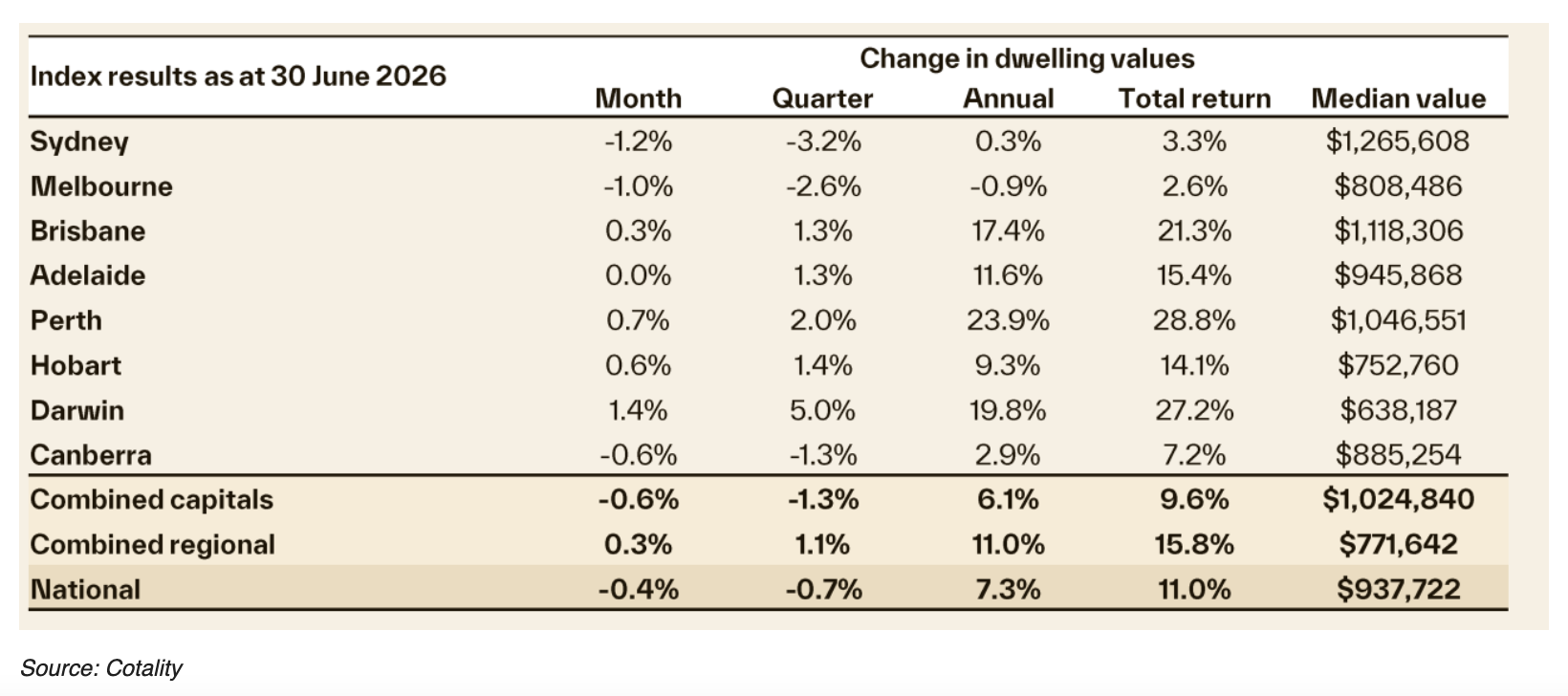
The common theme across the data is a broad-based loss of momentum, with auction clearance rates falling below 50% and advertised listings climbing, giving buyers more choice and greater negotiating power than at any point in the recent upcycle. As Cotality's research director Tim Lawless noted, "such low clearance rates indicate a mismatch between buyer and seller pricing expectations." Notably, the rise in listings reflects an accumulation of unsold stock rather than a pick-up in new-for-sale supply — while new housing construction remains constrained, with approvals and commencements improving only slowly and taking time to flow through to completions.
Rental conditions stayed tight, with national rents up 0.4% in June and 5.9% annually, keeping vacancy rates well below long-term averages.
Looking ahead, conditions are expected to remain cautious and uneven. Federal Budget changes to negative gearing and capital gains tax are set to further dampen investor demand, while deeply pessimistic consumer sentiment continues to weigh on turnover. Tight labour markets and constrained supply should help limit the risk of a sharp correction, but the near-term balance of risks has tilted further to the downside.
As noted previously, the uncertainty in the market moving forward is a timely reminder that property should be viewed as a long-term investment. It is very hard to time the bottom of the market, and buyers who wait for certainty often miss the opportunity altogether. There are some good buying opportunities in the current market — the important thing is to stay focused on the underlying goal of the investment, or your requirements as an owner-occupier, rather than short-term price movements.
Until next quarter,
Kellie Landrey | Principal Buyers Agent