Happy New Year from Scoutable and welcome to our Quarterly Wrap Up.
I hope you are well.
Cash Rate
At its December meeting, the Reserve Bank of Australia left the cash rate at 4.35%, after increasing it by 0.25% in November 2023. The Reserve Bank will hold its first cash rate meeting for 2024 in February and has indicated further rate raises may be required, pending the progress of inflation.
In an article released by the AFR, "RBA rate relief arriving in September: economist survey", 2nd January 2024, Cecile Lefort discussed various economist predictions for cash rates throughout 2024. 40 economists were asked their prediction, the median showing the RBA will start cutting rates in September 2024, with a cash rate forecast of 4.1% by December 2024 and 3.35% by December 2025.
Market Update
CoreLogic’s national Home Value Index (HVI) rose 8.1% in 2023, following -4.9% in 2022 and +24.5% in 2021. HVI 4th quarter growth for 2023 was 1.5%, down from Q3’s growth of 2.2%. Looking at the Home Value Index of capital cities for Q4 2023, a gain of 0.8% was reported in Sydney, -0.2% in Melbourne and +3.7% in Brisbane. Perth lead the chart with a 5.1% gain.
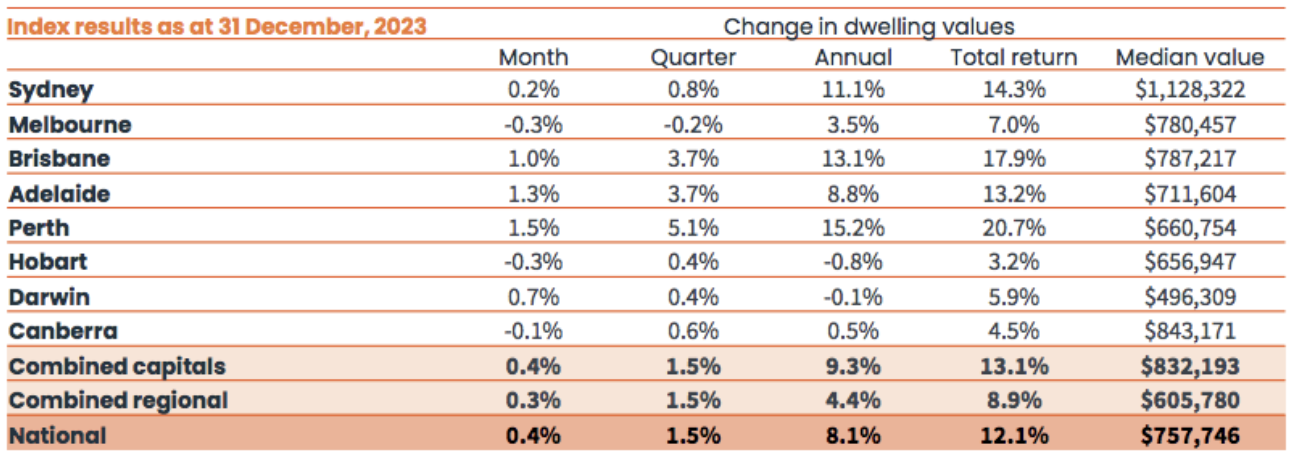
Source: CoreLogic
The national growth for December was reported at 0.4%, which is the smallest gain since values started rising in February 2023. Tim Lawless, CoreLogic’s research director, noted, “After monthly growth in home values peaked in May at 1.3%, a rate hike in June and another in November, along with persistent cost of living pressures, worsening affordability challenges, rising advertised stock levels and low consumer sentiment, have progressively taken some heat out of the market through the second half of the year.”
CoreLogic & ANZ’s Housing Affordability Report showed over the first three quarters of 2023 (to September), it would take the average household 10 years to save a 20% deposit, average households are using 46.2% of income to service a mortgage and for average households renting, 31% of income is needed to pay rent.
Looking forward 2024
SQM Research produce a forecast report each year, Christopher’s Housing Boom and Bust Report. The 2024 report was released 21st November 2023.
The base case forecast is for average national dwelling prices to change between -1% to 3%.
The forecasts are based on two important assumptions:
The rate of net short term and longer-term migration is expected to peak next year and then ease, so total population growth for 2024 falls back to around 460,000 people.
The rate of inflation is expected to continue to ease to back to between 3 to 4 per cent by the end of 2024.
Christopher’s Housing Boom and Bust Report 2024 noted on their assumptions: "As such and as is normal for its annual forecast, scenarios have been represented whereby migration rates do not slow next year and inflation reignites.
If Australia’s migration rates fail to slow as anticipated, this would likely mean SQM’s base case forecasts of a mild correction would not materialise. On the other hand, housing price falls could be more acute if inflation were to accelerate to the point of forcing the Reserve Bank of Australia to lift the cash rate beyond 5%. To this end, SQM has built out a scenario based on a second energy crisis, driven by current events in the Middle East. Such a scenario would force the RBA to lift interest rates more aggressively over 2024 and very likely trigger a sharp recession for Australia".
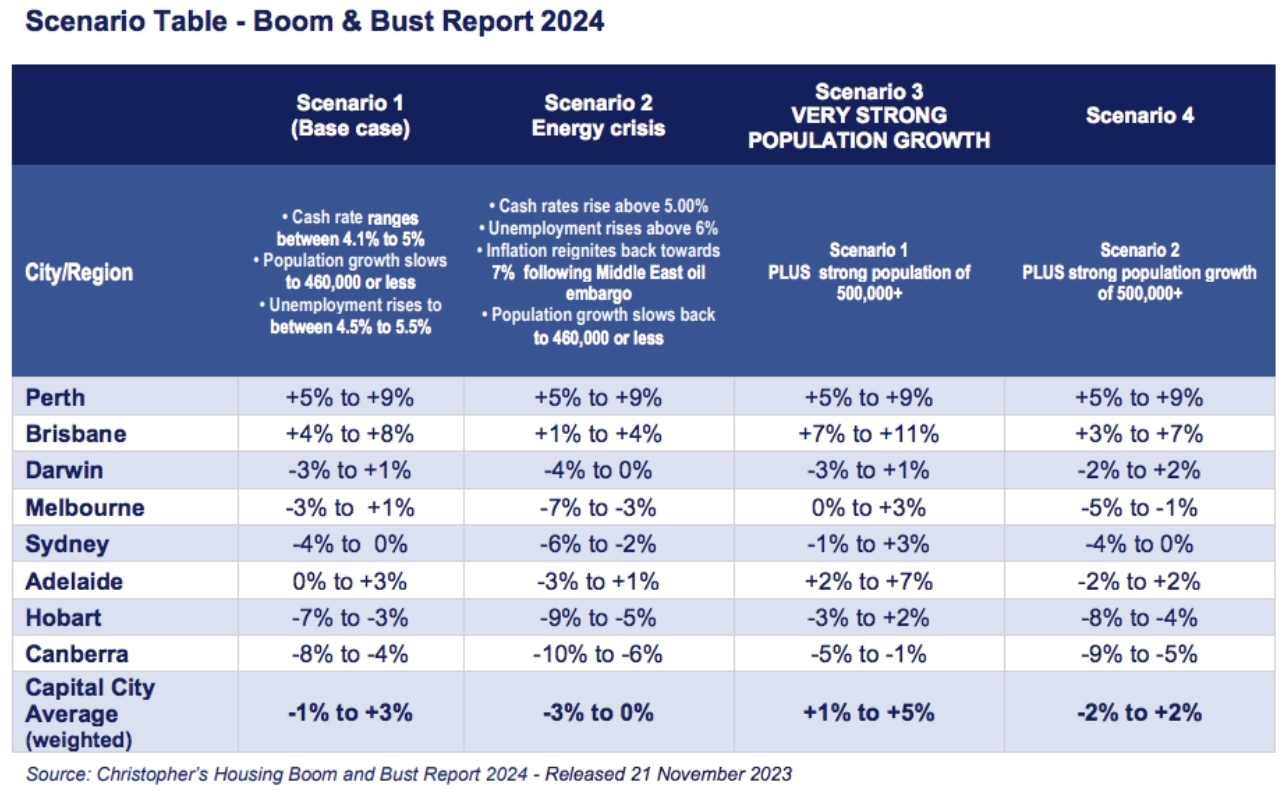
Of course, each city/region has different market movements within various suburbs. Sydney, for example, according to Christopher’s Housing Boom and Bust Report, is expected to have a moderate fall in dwelling prices between -4% to 0%. However, the middle to outer ring will record a greater correction (for freestanding dwellings), whereas the inner ring is expected to record price rises.
CoreLogic HVI notes on the market for 2024 "The trends from late 2023 are pointing towards a milder outcome for housing values in early 2024, with the potential for a year of two halves. In the first half of 2024, dwelling value growth will be tested by the interaction of high interest rates and weaker economic conditions, both of which are likely to weigh on housing activity."
"The trajectory of interest rates through 2024 will be a key factor influencing housing trends. Although another cash rate hike can’t be completely ruled out, the trend towards lower inflation, weakening economic conditions amid low consumption and a loosening labour market, suggests another rate hike is looking increasingly unlikely. A reduction in the cash rate target through 2024 could help to re-stoke demand later in the year.
At the end of December, financial markets were fully pricing in a 25 basis point rate cut by June 2024. If interest rates do move lower, there is a good chance we will see a lift in consumer sentiment and a more positive trend in housing activity and values through the second half of the year, although an easing in macroprudential policy settings is not a given"
Global events, net migration, affordability constraints, interest rate movements, APRA serviceability buffer rate (rate which is applied to loan serviceability assessments), supply and consumer confidence are key factors to market movements over the next 12 months. Pending the outcome of the various elements, we could see the market slightly correct, remain flat or continue to rise. The unknowns of the market moving forward is a timely reminder that property should be viewed as a long term investment. The focus therefore should be on:
completing due diligence (suburb research, price analysis, building / strata inspections etc),
asking is the property right for me?
asking can I afford the property?
asking will I be holding the property long term?
As long as you do not overextend yourself you will be able to ride out any short term movements in the market.
If you would like to discuss the property market further, please get in touch.
Until next quarter,
Kellie Landrey | Principal Buyers Agent