
Greetings from Scoutable and welcome to our Quarterly Wrap Up.
I hope you are well.
Cash Rate
At its May meeting, the Reserve Bank of Australia (RBA) cut its cash rate by 25 basis points to 3.85%. Westpac, ANZ, NAB and CBA are all expecting a further rate cut of 0.25% at the RBA’s meeting next week.
Market Update
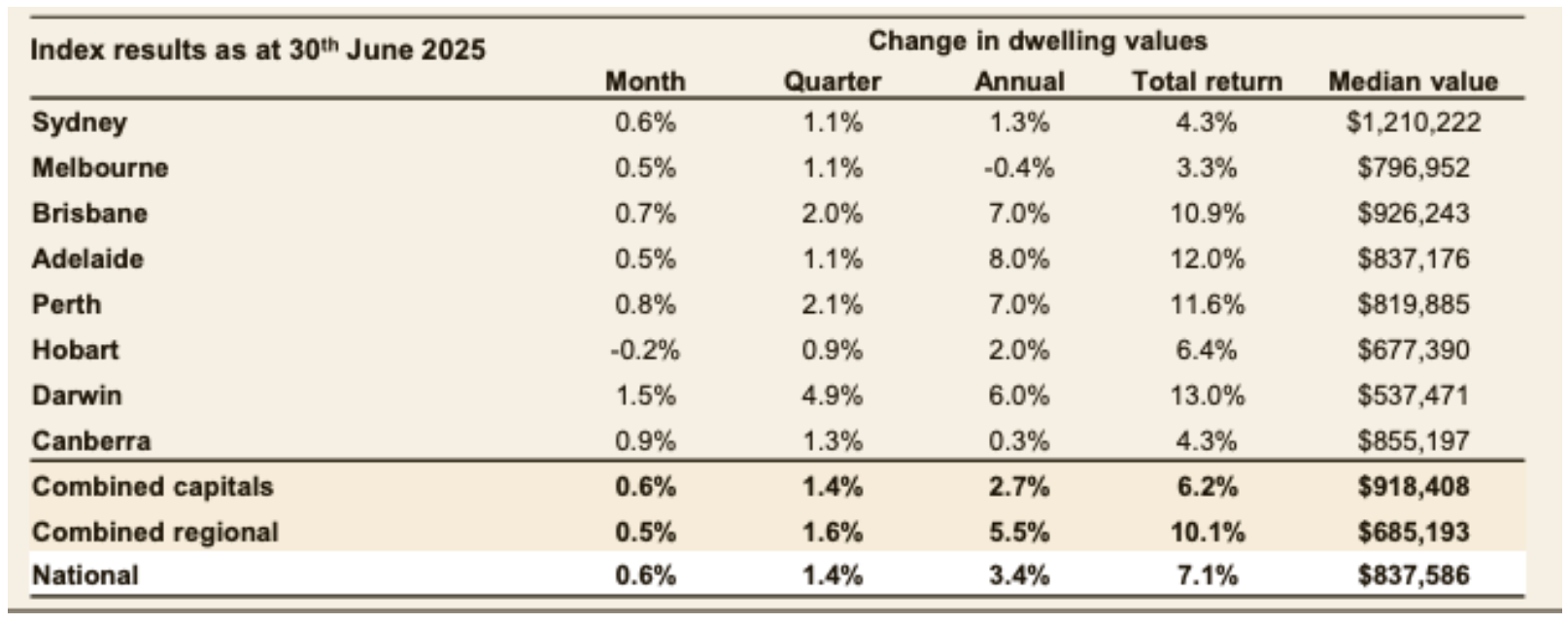
Please find summary below of Cotality (formerly known as CoreLogic) Home Value Index (HVI), released July 1st.
National Housing Market Performance
The Cotality Home Value Index (HVI) recorded Australian home values rose 0.6% in June, continuing five straight months of growth
The June quarter saw a 1.4% national gain, driven by falling interest rates and improved buyer sentiment
Cotality’s research director, Tim Lawless, noted "falling interest rates have been a clear catalyst behind the renewed momentum. The first rate cut in February was a clear turning point for housing value trends. An additional cut in May, and growing certainty of more cuts later in the year have further fuelled positive housing sentiment, pushing values higher. Although value rises have been broad-based, the pace of growth remains mild compared to mid-2023 when the quarterly rate of growth in national home values peaked at 3.3%, and for that matter, positively tepid relative to the extreme 8.1% quarterly peak growth recorded through the height of the pandemic.”
However, the current housing rebound is occurring against relatively low home sales. Housing turnover through the first half of the year, based on estimates of sales and total dwelling stock, is tracking at an annualised pace of 4.9%, slightly below the decade-average turnover of 5.1%. Further, advertised stocks levels are low, -5.8% below same time last year and -16.7% below previous five year average.
Capital City Highlights
Capital cities are starting to outpace regional areas, though quarterly growth still slightly favours regional markets (1.6% vs 1.4%). Darwin led the capitals this quarter (+4.9%), reaching a record high. Perth and Brisbane also performed strongly, with five-year growth of 81.1% and 75.1% respectively. Despite growth, housing turnover and listings remain below average, keeping market conditions balanced.
Rental Market Insights
Rental growth continues to slow, with national rents rising 1.3% in Q2—the lowest since 2020. Darwin (+2.9%) and Brisbane (+2.0%) led growth, while ACT (+0.3%) was the weakest.
Annual rental growth now sits at +3.4%, well down from the 2021 peak of 9.7%.
Affordability constraints (renters are spending around 33% of pre-tax income on rent) and easing migration are contributing to softer rental demand
Despite slowing growth, vacancy rates remain low (~1.5%), well below the pre-COVID average of 3.3%.
Market Drivers
Interest Rates: Further cuts expected, with the cash rate forecast to fall to 3.1% by year-end
Labour Market: Tight conditions continue to support confidence and borrowing capacity
Supply: New housing approvals remain low, adding pressure to prices amid rising demand
Affordability: Rising prices and high debt levels may limit the extent of any market upswing
Geopolitical Risk: Conflict in the Middle East, US tariffs and the ongoing Ukraine war could weigh on consumer sentiment & disrupt economic conditions
While lower rates and tight supply support modest value growth, affordability challenges and cautious lending are expected to keep gains contained through the rest of 2025.
Looking Forward
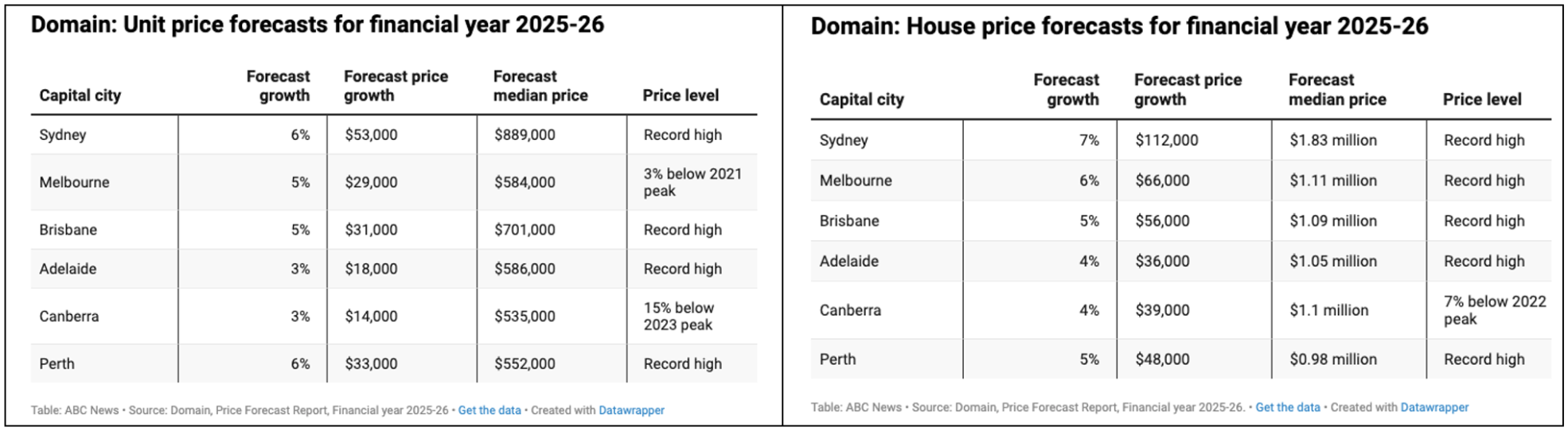
According to Domain's latest Price Forecast Report (released 18th June 2025), Sydney and Melbourne are projected to lead Australia's housing market in the coming year. In Sydney, the median house price is expected to increase by 7% to reach $1.83 million by June 2026, marking a rise of $112,000—surpassing the average full-time annual wage of $103,000. Melbourne's median house price is anticipated to grow by 6% to $1.1 million, recovering from two years of decline. Meanwhile, property prices in Brisbane, Adelaide, and Perth, once considered more affordable, are showing signs of cooling, though not sufficiently to alleviate the challenges faced by first-home buyers.
Nicola Powell, Domain's chief of research and economics, noted - "Growth will slow compared to past cycles, but affordability is still a major barrier, with housing costs consuming a large portion of household income".
Please see tables below.
If you would like to discuss the property market further, please get in touch.
Until next quarter,
Kellie Landrey | Principal Buyers Agent