
Greetings from Scoutable and welcome to our Quarterly Wrap Up.
I hope you are well.
Cash Rate
At its April meeting, the Reserve Bank of Australia left the cash rate at 4.10%, after dropping rates by 25 basis points (4.35% to 4.10%) a its March meeting. This was the first time rates were lowered since November 2020. Westpac, National Australia Bank and Commonwealth Bank are all expecting three more cash rate cuts this year, despite recent geopolitical tensions. More conservatively, ANZ, anticipates just one more rate cut in 2025 and does not expect to see the RBA make this move until August.
Federal Budget
The Australian Government's 2025–26 Federal Budget introduces several initiatives aimed at addressing housing affordability and supply:
National Housing Accord: A commitment to construct 1.2 million new, well-located homes over five years, with nearly 45,000 homes completed in the first quarter.
Housing Australia's Liability Cap Increase: An increase in Housing Australia's liability cap from $10 billion to $26 billion, enabling greater investment in social and affordable housing projects.
Infrastructure Investment: Allocation of $1.5 billion for infrastructure projects to support housing development, aiming to enhance housing supply and affordability.
Expansion of Prefabricated and Modular Housing: A $54 million investment to expand prefabricated and modular housing construction, intended to improve efficiency and reduce costs in the housing supply chain.
Help to Buy Program Expansion: An $800 million expansion of the Help to Buy scheme, increasing caps on property values and buyer incomes to assist approximately 40,000 Australians in entering the housing market.
Funding for Homelessness Services: $9.3 billion will be spent on combatting homelessness with crisis support and social housing, while $6.2 million will be spent on research and advocacy on issues surrounding homelessness.
More details: Budget 2025 - 2025 - Housing
Low to Mid-Rise Housing Policy
The Minns Labor Government’s Low and Mid-Rise policy is set to deliver 112,000 homes across New South Wales over the next five years as the next stage of the policy comes into effect. The policy came into effect on 28th February 2025. The new reforms change planning controls within 800 metres, or 10-minute walk, around 171 town centres and stations to allow dual-occupancies, terraces, townhouses and residential flat buildings across metropolitan Sydney, the Central Coast, Illawarra-Shoalhaven and Hunter regions. The NSW Government’s changes will remove the restriction on developing terraces, townhouses and low-rise residential flat buildings on R1 and R2 zoned land, while also removing the restriction on delivering medium rise residential flat buildings on R3 and R4 zoned land in these areas.
Market Update
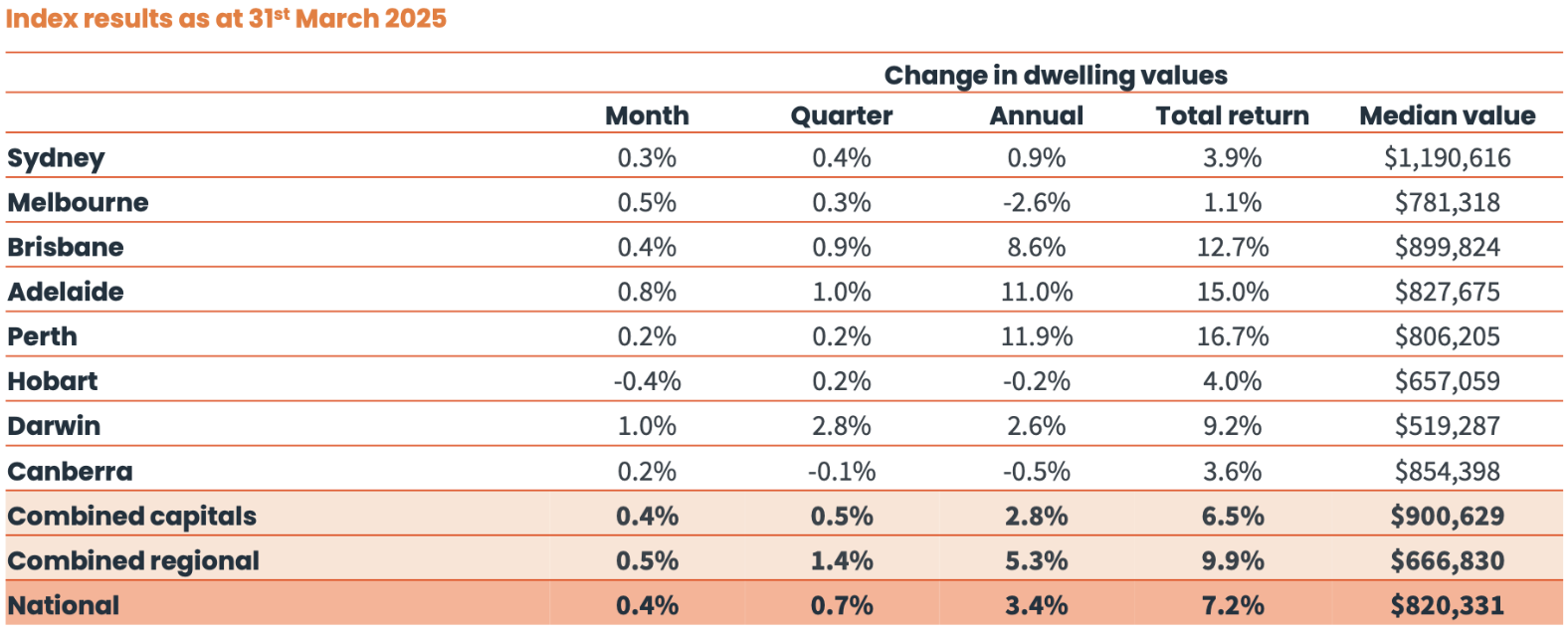
Please find summary below of CoreLogic Home Value Index (HVI), released April 1st.
National Housing Market Performance
The CoreLogic Home Value Index (HVI) recorded another monthly increase of 0.4% in March 2025.
This marks the second consecutive month of growth after a brief three-month downturn where values declined by 0.5%.
All capital cities except Hobart saw home value increases.
Regional markets outperformed capital cities in annual growth but are now showing signs of convergence as capital city trends accelerate.
Capital City Highlights
Sydney & Melbourne: The two largest property markets have turned positive after months of declines.
Sydney home values dropped -2.2% between September 2024 and January 2025, but recent growth has left them only 1.4% below their previous peak.
Melbourne, which peaked in March 2022, is still 5.6% below its record high but has gained 0.9% over the past two months.
Perth, Brisbane & Adelaide: These mid-sized capitals have shown strong long-term gains, though Perth’s market has slightly slowed.
Perth saw a 75.4% increase in values since March 2020, leading the nation over the past five years.
Brisbane and Adelaide remain at peak levels.
Hobart & Canberra: More sluggish, with Hobart recording the only monthly decline (-0.4%).
Rental Market Insights
National rental index rose 0.6% in March, the same pace as February, but lower than the 1.0% increase seen this time last year.
Annual rental growth slowed to 3.8%, down from a peak of 9.7% in November 2021.
City with highest monthly rental growth: Hobart (+1.2%).
City with lowest monthly rental growth: Melbourne (+0.3%)
Regional rental trends: Rental growth is still positive, though demand is cooling slightly.
Rent growth is slowing, but rents are at record highs, keeping yields attractive for investors.
Market Drivers
Interest Rates & Credit Conditions
The cash rate is expected to be reduced by 75 basis points, reaching 3.35% by the end of 2025, but still above the RBA's neutral estimate of 2.9%.
Mortgage serviceability remains challenging, with the national dwelling value to household income ratio at 8.0, near record highs.
Households dedicating 50.5% of their gross income to mortgage repayments (assuming a 20% deposit).
Cost of Living & Labour Market
Real household disposable income is projected to grow by 2.5% in 2025, helping with savings and affordability.
The national unemployment rate is 4.1%, showing labour market resilience, but February data hinted at weaker job growth.
Consumer Sentiment & Housing Demand
Consumer sentiment has improved due to easing inflation and expected interest rate cuts, which could drive housing activity.
Population growth normalising, reducing overall housing demand. Levels are back to matching the pre-COVID decade average.
Supply & Affordability Challenges
New housing supply remains constrained due to high construction costs, labour shortages, and tight developer margins.
Housing construction costs continue to rise, making new projects less feasible.
The competition for tradespeople from the infrastructure sector is expected to persist for several years.
Corelogic's HVI noted - With two months of growth in Australian home values now on the scorecard, it's looking more convincing that the positive turn is more than a temporary recovery… but a material upswing in values remains unlikely. On the upside, a gradual easing in monetary policy, cost of living relief, income growth, tight labour markets and improved sentiment are all likely to support housing sector activity. On the flip side, a variety of headwinds are likely to at least partially offset the tailwinds, keeping value growth contained. The rate-cutting cycle is likely to be drawn out, housing remains unaffordable, population growth has reduced to more normal levels and housing credit policies remain risk averse.
If you would like to discuss the property market further, please get in touch.
Until next quarter,
Kellie Landrey | Principal Buyers Agent