Happy New Year from Scoutable and welcome to our Quarterly Wrap Up.
I hope you are well.
Cash Rate
At its December meeting, the Reserve Bank of Australia left the cash rate at 4.35%, for a ninth straight meeting. The Reserve Bank will hold its first cash rate meeting for 2025 in February.
In an article released by the ABC, 'The RBA is expected to cut interest rates this year. Here's what to watch', 6th January 2025. It was noted – “As with all forecasts, it depends who you ask, but many economists have pencilled in May as the first interest rate cut. That includes ANZ, NAB and Westpac economists, who are all expecting a 25-basis-point cut at the May meeting, which would take the cash rate to 4.1 per cent. The Commonwealth Bank's economics team is sticking by its call that the first rate cut will come in February, but acknowledges there is doubt around it after stronger-than-expected data on the jobs market. As for financial markets, an indicator of expectations calculated by the ASX puts the chance of a cash rate cut in February at 73 per cent".
Market Update
CoreLogic’s national Home Value Index (HVI) rose 4.9% in 2024, following 8.1% in 2023, -4.9% in 2022 and +24.5% in 2021. HVI 4th quarter for 2024 reported a decline of -0.1%, down from Q3’s growth of 1%. Looking at the Home Value Index of capital cities for Q4 2024, -1.4% was reported in Sydney, -1.8% in Melbourne and +1.3% in Brisbane. Adelaide lead the chart with a 2.1% gain.
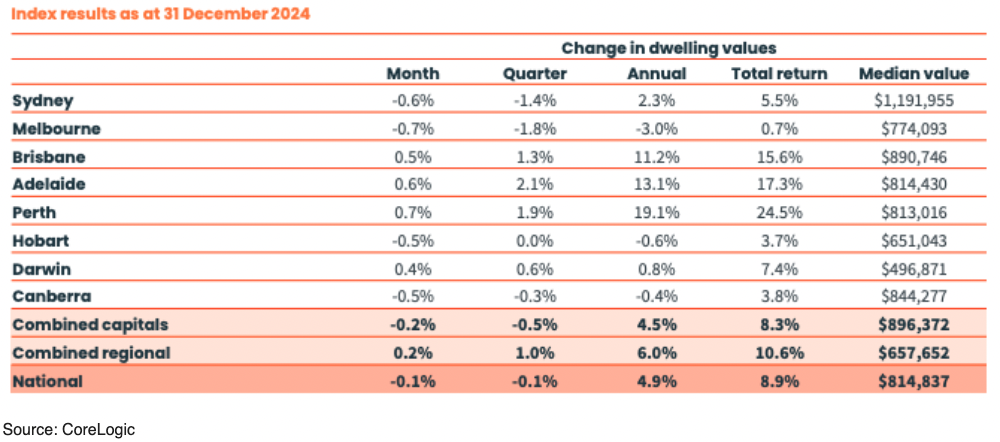
Tim Lawless, CoreLogic’s research director, noted, “The decline in values is no surprise. This result represents the housing market catching up with the reality of market dynamics. Growth in housing values has been consistently weakening through the second half of the year, as affordability constraints weighed on buyer demand and advertised supply levels trended higher. The first half of 2024 saw national home values rise 4.1%, before slowing to just 0.7% through the second half of the year, with five of the eight capitals recording a decline in values between July and December".
Looking forward 2025
CoreLogic HVI suggests a soft start with potential for modest rebound in 2025. Noting the following:-
Interest Rate Cuts: Financial markets expect a series of interest rate cuts in 2025, potentially offering relief to borrowers. While this is expected to boost housing demand and consumer sentiment, lower rates are unlikely to spark a full recovery in value growth. The cash rate is anticipated to fall by 25 basis points by April, with further cuts throughout the year.
Macroeconomic Factors: Changes to macro-prudential policies, including potential adjustments to the mortgage serviceability buffer, could influence housing demand as interest rates decrease. However, elevated household debt levels could lead to new regulatory measures to prevent financial instability.
Migration Trends: Net overseas migration, which peaked in 2022-23, is set to ease in 2025, which may reduce rental and home purchasing demand. The anticipated slowdown in immigration is expected to have a cooling effect on housing markets, especially in areas heavily influenced by migration.
Housing Supply and Affordability: The shortage of newly built housing will likely persist, supporting housing values until new supply catches up. However, affordability is expected to improve slightly in 2025, as income growth outpaces home value increases, and interest rates begin to reduce. Additionally, rental markets may stabilise, and cost of living pressures could ease, providing some support for demand.
In summary, while 2024 was a year of slowing growth, 2025 is expected to start on a softer note, with key factors such as interest rates, migration trends, and housing supply influencing the market. Although we don’t expect a strong rebound, gradual improvements in affordability and ongoing supply challenges could help stabilise home values.
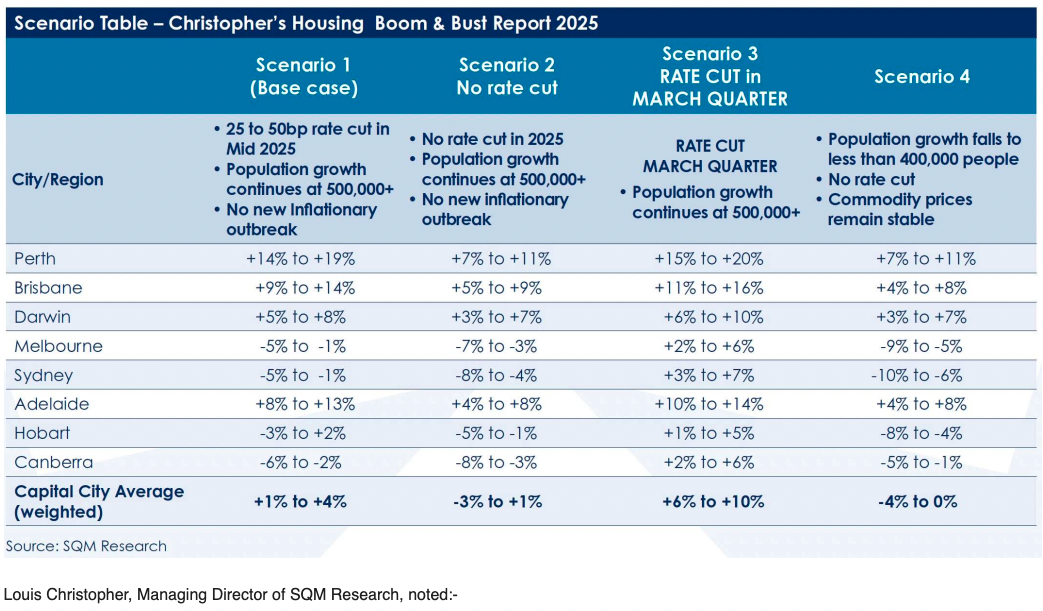
SQM Research produce a forecast report each year, Christopher’s Housing Boom and Bust Report. The 2025 report was released 26th November 2024.
The Base case forecast is for average national dwelling prices to change between +1% to 4%.
The forecasts are based on three important assumptions:
1) The rate of population growth is expected to remain strong with an anticipated population expansion of another 500,000+ people over 2025.
2) There will be no new inflationary outbreak next year.
3) The Reserve Bank of Australia (RBA) will cut interest sometime mid 2025 by between 0.25% to 0.50%.
Christopher’s Housing Boom and Bust Report 2025 noted on their assumptions: "As is normal for its annual forecast, scenarios have been represented whereby migration rates do slow next year and interest rates are cut sooner than expected or they will not be cut at all"
Louis Christopher, Managing Director of SQM Research, noted:-
“Another strong year of population expansion which will almost be double Federal Treasury forecasts; plus, an ongoing shortage of new dwellings, limited expected housing price falls in Sydney and Melbourne over 2024 and saw strong price gains in Perth, Brisbane and Adelaide.
“For 2025, we are not anticipating much of a change in these current trends. However, we are now anticipating a cut in interest rates starting from mid-year which will continue the price rise momentum in Perth, Brisbane and Adelaide and keep the price falls in Sydney and Melbourne to single digits.
“To be sure, our two largest capital cities, along with Canberra and Hobart will start 2025 off in the red. Indeed, we are currently recording dwelling price falls in each of these cities. Current interest rate settings are biting the community more in these cities which on our measurements, are in overvalued territory and/or are experiencing slower economic growth compared to the cities (and states) that have enjoyed good economic growth through a buoyant commodities market and/or have had generous contributions from GST receipts.
“However, once interest rate cuts do occur, we are expecting a speedy bounce in demand for Sydney and Melbourne in particular, which both are still experiencing underlying housing shortage relative to the strong population growth rates. This may well mean there is a good window for buyers at this time for our two largest capital cities. However, if I am wrong and rate cuts do not occur in 2025, it is unlikely a recovery will occur in Sydney and Melbourne at any time next year.”
As noted last year, global events, net migration, affordability constraints, inflation, interest rate movements, APRA serviceability buffer rate (rate which is applied to loan serviceability assessments), supply and consumer confidence are key factors to market movements over the next 12 months. The unknowns of the market moving forward is a timely reminder that property should be viewed as a long term investment.
If you would like to discuss the property market further, please get in touch.
Until next quarter,
Kellie Landrey | Principal Buyers Agent